GENESIS
A person gives a world its beginning. A name, words and a rhythm establish its first state.
They accumulate.
They remember.
They do not reset.
TAHN transforms signals from bodies, places and the planet into structures that retain what has already happened. His current practice converges in Living Universe Systems — artworks whose previous states become the conditions of what comes next.
ZERO POINT OF THE CURRENT PRACTICE
First public working instance · 2026
One person. One genesis. One accumulating history.
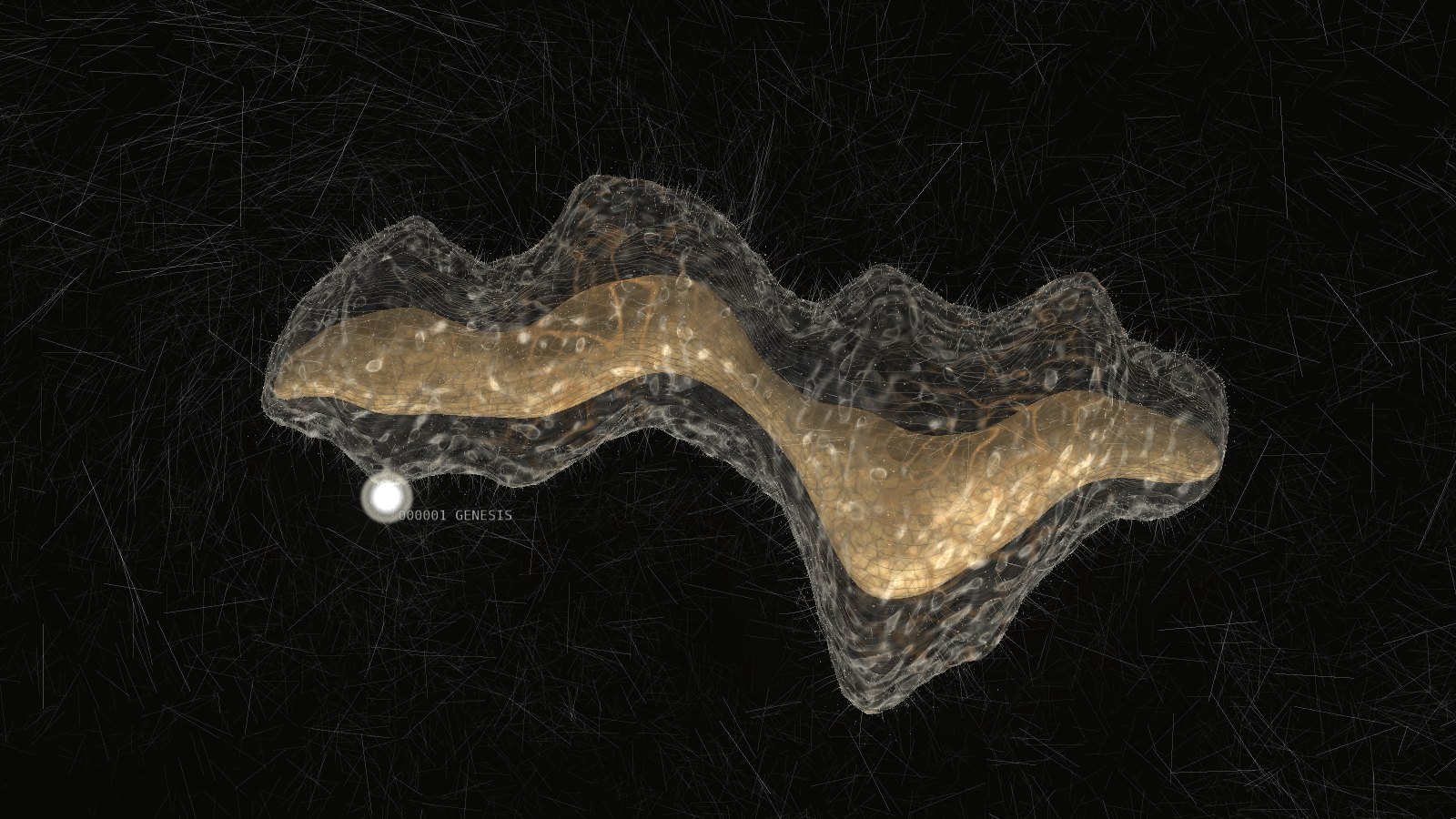
Live rendering unavailable in this browser.
WebGL is off or unsupported, so a still of the working field is shown. Open the work in Chrome, Edge, Safari or Firefox with graphics acceleration enabled. Open the work →
PRIVATE UNIVERSE #000 is the first public working instance of Living Universe Systems. Earlier investigations into memory, closed artist-owned data, measurement, bodily signals and no-reset systems converge here as a single artistic proposition: an individual universe that carries the history of its encounters.
Everything before #000 converges here.
Everything after #000 begins from here.
Public web instance: manual/simulated biosignals, optional USB sensor input, browser-local memory. Material output and a persistent installation archive are in development. The current procedural renderer does not yet use the 101 drawings or custom LoRA.
HOW THE PRACTICE ARRIVED HERE
These are four strands of an evolving practice. They converge in #000; they are not four versions of the same artwork.
MEMORY REWRITTEN
101 ORIGINAL DRAWINGS / CLOSED DATASET
An authored archive establishes the visual language and the boundary of what can be recombined.
101 SEAMS — LOCAL FIELD
LOCAL UNIVERSE · CALENDAR FIELD
Drawings, local signals and declared time produce different readings of the same world. No single measurement stands for the whole.
QUAKE SCAR
THERMAL RESIDUE
Seismic marks accumulate on displays. Thermal traces make the vulnerability of a material record visible. Persistence and fading become artistic conditions.
STRATA OF BREATH
PRIVATE UNIVERSE #000
Bodily encounters and layered time meet in the current direction: individual systems whose accumulated states shape what can happen next.
LOCAL FIELD asks how a place is read. LOCAL UNIVERSE asks what its invisible conditions leave behind. CALENDAR FIELD asks how one declared time is read by different systems. PRIVATE UNIVERSE carries the next question: can an individual world retain the events that have shaped it?
A living online archive that places 101 field drawings beside the same site as sensed through anonymous wireless conditions. Rather than reproducing the drawings, the system translates line, density, interval, empty space, and fracture into seam-like structures. Human perception and machine sensing remain as two incomplete readings of place, stitched together rather than resolved.
LOCAL FIELD is not a single finished image but a growing field of encounters. The work holds together the artist’s embodied reading of place and the machine’s anonymous sensing as seam, tension, and record.
A site-responsive online archive that observes anonymous 2.4 GHz Wi-Fi field conditions and translates signal count, strength, deviation, and channel structure into suns, moons, mountains, orbits, stars, and accumulating strata. It records no SSIDs and identifies neither devices nor people; what remains is the invisible condition of a place.
Unlike the moving-image works below, LOCAL UNIVERSE continues to change with the field around it. Tahnverse remains the curatorial portal; the external archive remains the work’s live operating environment.
When a participant declares a name and a date, Western zodiac, the animal cycle, Four Pillars, the 60-cycle, and the relation to the present read the same coordinate differently. A talisman is then generated through Tahn’s structural language, and only when the participant chooses to settle it does an anonymous coordinate enter the collective archive. No single reading represents the whole person.
One date is read by several systems, but none is the whole. Names and original inputs do not remain in the collective archive, and no talisman image file is stored. What is preserved is not the image, but an anonymous coordinate and the rule by which the image can return.
Below is a compact set of time-based works for jury and curatorial review: memory, tradition, public media, and signal-based image systems.
Before the algorithm, there is the hand. Tahn’s 101 original drawings form an artist-owned visual corpus. A custom LoRA model carries selected relationships—density, interval, contour, fracture, grain, and temporal rhythm—into generative fields that can be reorganized by live signals. The method keeps authorship and perceptual logic traceable without reducing the work to prompt aesthetics.
The closed dataset + custom LoRA is an established method within this practice. PRIVATE UNIVERSE #000 currently uses a procedural renderer; the 101 drawings and custom LoRA are not yet connected to this web work.
101 hand-drawn works form the artist-owned visual corpus and its ethical boundary. The closed dataset contains no external image material.
A custom model learns relationships among density, interval, contour, grain, fracture, surface pressure, and spatial rhythm rather than reproducing a fixed image style.
News, sound, EEG, breath, attention, and environmental signals can reorganize the trained field, so memory behaves as a changing structure rather than a fixed image output.
Artist-owned drawings establish the visual corpus and ethical boundary.
The model learns structure, density, grain, fracture, and temporal rhythm.
Live signals continuously reorganize the trained field into an evolving time-based system.

Selected works can be realized as single-channel moving image, multi-screen projection, sensor-responsive installation, public media façade, or research-based participatory system. A modular real-time engine, local playback, fallback states, and site-specific projection mapping allow each work to adapt to spatial and technical conditions without changing its conceptual logic.
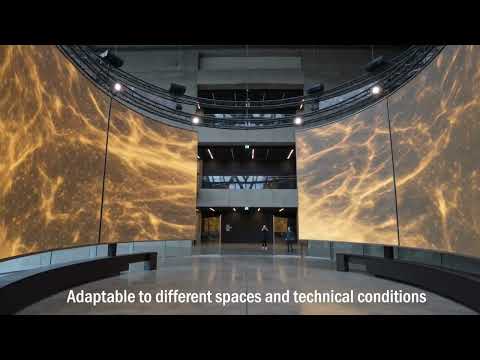
This conceptual spatial visualization is not documentation of a completed installation. It is a scenario study used to test scale, atmosphere, projection logic, visitor movement, and site-specific adaptation.
Open on YouTubeI build artworks that remember. Signals from bodies, places and planetary systems become structural traces; the next event encounters what the previous one has left. My practice has developed through a closed artist-owned dataset + custom LoRA, live sensing, participatory archives and no-reset systems. These lines now converge in Living Universe Systems.
I was born into a country that had just emerged from the devastation of war. My parents’ generation fought for survival and reconstruction; my generation inherited a different war, one of identity, adaptation, and attention in an accelerated technological era.
My red-green color vision difference is not a biographical anecdote, a deficit, or a claim that I simply “see structure better.” It makes the idea of a standard observer unstable: who defines normal perception, and what becomes illegible when color is treated as universal? Structure, density, texture, interval, fracture, luminance, and spatial pressure therefore operate as parallel perceptual languages in my work.
My work brings Korean symbolic systems such as Ilwolobongdo, moon jars, folk talismans, and ritual architectures into contact with computational vision, EEG, breath, environmental signals, and generative systems. I do not use technology to decorate tradition. I use it to test how inherited forms persist, mutate, and acquire new agency under contemporary conditions.
In my installations, time is not a neutral background. It is a material. Memory is not an archive. It is a living organism. The audience is not a visitor outside the work. They become a force inside its field.
Selected artist, International Symposium on Electronic Art, Dubai, United Arab Emirates.
Finalist, Top 3. International jury; ceremony presented by the Director of Guggenheim Abu Dhabi.
Watch event videoVisual Arts Commission, Ministry of Culture, JAX District, Riyadh, Saudi Arabia.
Official media facade screening within Riyadh Art public art context, Saudi Arabia.
Data and AI, Imaginary Landscapes, Fictional Narratives, three-person exhibition.
Platform exhibition, collaborative project with Pozamong.
PDF materials are provided for curators, juries, residency panels, commissioners, and press review.
Focused inquiries are welcome from museums, biennials, public art programs, cultural foundations, universities, curators, collectors, and commissioning bodies seeking media works grounded in time, memory, attention, and place.
Single-channel moving image, multi-screen installation, generative time-based installation, sensor-responsive environments, and live participatory archives can be configured for museums, festivals, and curated programs. Works such as CALENDAR FIELD can scale as an interactive terminal plus an archive display or projection.
Site-specific public media rituals for façades, civic screens, airports, cultural plazas, and architectural surfaces where Korean symbolic systems meet contemporary urban memory.
Inquiries regarding editioned media works, institutional acquisition, closed-dataset generative works, provenance documentation, and long-term preservation materials.
Artist talks and workshops on chronotopic media art, non-standard perception, artist-owned dataset authorship, biosignal interaction, and public media practice.
For site-specific commissions, acquisitions, exhibitions, public media projects, or research collaborations, please outline the institutional context and technical conditions. This form is configured for Netlify Forms after deployment; direct email remains available below.
For curatorial review, commission proposals, public media projects, artwork acquisition, artist talks, and workshop invitations, please contact Tahn directly.
tahn.artist@gmail.com